
A Physiotherapist Reveals Why Your Back Won't Straighten. And the 15 Minutes That Finally Changed His
★★★★★ 2,847 reviews · Physiotherapist. Father. 19 years in practice. £14,700 spent on his own spine. And the 15 minutes that finally changed everything.
Back clinics are going to hate me for writing this.
Not because it's wrong. Because it's going to cost them a fortune in repeat bookings.
My name is Robert Steiner. I'm 54. I've been a physiotherapist for 19 years. A husband. A father of two boys.
And I'm about to tell you something that most people in my profession will never say out loud. Because the moment they do, you stop coming back. And that's bad for business.
The back pain industry makes its money from managing you. Not from fixing you.
The longer your back hurts, the longer you keep booking appointments. And most of my colleagues know it.
I know it too. I've known it for years. But it took three years of pain, £14,700 in treatments, and the worst night of my life to finally do something about it.
September 14th
My youngest son Daniel got married last September. Outdoor ceremony at an old farmhouse outside Cologne. Eighty guests. Warm evening. Everything you'd want for your kid.
I spent the entire ceremony thinking about one thing.
Whether anyone could see the lean.
My spine had been curving for three years by then. One shoulder slowly rising higher. Torso drifting to one side. I'd catch my reflection in a shop window and not recognise the man tilting sideways.
When the ceremony ended, everyone stood. I stood. Left shoulder hitched two inches higher than the right. The familiar tilt. Body listing to the right. The tilt you can't hide.
Petra reached for my arm. Not to hold my hand. To steady me. Like she was bracing something that might lean further.
Daniel looked at me from the altar. At his father, standing crooked at his wedding. He looked away.
After the ceremony, the photographer gathered us outside. Family photo. Father and son. I stood as straight as I could. Muscles on my right side burning. Five seconds. The shutter clicked. I exhaled. Tilted back.
That evening, Petra scrolled through the photos on her phone. She stopped at the family portrait. Everyone standing straight. Except me. Left shoulder visibly higher. Torso leaning. Daniel had his hand on my back. Not around my shoulder. On my back. Holding me level.
My 28-year-old son was holding his father upright for a wedding photo.
Later there was dancing. Our song came on. Petra looked at me. I shook my head. Not because of pain. Because I'd be tilting. Leaning. Everyone would see. She danced with Daniel instead.
I sat at the table and watched my wife dance with my son at his wedding. Because I could not stand straight for three minutes without my body tilting sideways.
I left early. Sat in the car in the driveway for twenty minutes. The house was dark. I didn't go inside.
I'm telling you this because I need you to understand what happened next. And why.
"I'm 59 and for the first time in five years, I stood at my granddaughter's school play without leaning against the wall. Not because my back is 'cured.' Because I finally found something that lets me stand straight, every single day, at home. My wife said I looked taller. I'm not. I'm just not shrinking sideways any more."
The Following Monday
I went back to work.
Nine o'clock. Mr Fairbanks. Sixty-three. Adult scoliosis. A lateral curve in his lower back that had been progressing for five years. When he first came in, you could barely notice the tilt. Now his left shoulder sat an inch higher than the right. His shirts hung unevenly. He couldn't stand in a queue without shifting his weight every thirty seconds. Fifty-five pounds a session. Five years. The curve was still getting worse.
I treated him. Same routine. Heat, manual therapy, exercises. Booked him for next week. Said "take care" like I always do.
And for the first time in nineteen years, I felt sick doing it.
Because I knew he'd be back. Next week. And the week after. And the week after that. Just like he'd been coming for five years. Just like I'd been going to my physiotherapist for three years.
Everyone treating. Nobody solving. And I was on both sides of the table.
What I Found at 2am
That Monday night I sat in the kitchen and started reading. Not the textbooks from school. The research that nobody in my profession talks about. Because it threatens the way we all make our money.
At two in the morning I found a long-term study of adults with progressive spinal curvature. Some of them kept doing what everyone does. Occasional sessions. General exercises. The others did daily, scoliosis-specific corrective work. Every single day.
Years later, the daily group showed measurably less curve progression. Not just less pain. Less curve. The spine was actually holding straighter.
I read it twice. Then I kept digging.
Study after study, from Zurich, Sydney, Toronto. All saying the same thing. Something so obvious I wanted to throw my laptop across the kitchen.
We've been treating the wrong thing. All of us. For decades.
Here's what I mean.
If you're over 50 and your back still hurts despite everything you've tried. The exercises, the stretches, the appointments, the pills. The problem is almost certainly not what you've been told.
It's not weak muscles. Not bad posture. Not "just getting older."
Those explanations sound medical. They're easy to accept. And they keep you booking appointments.
The real problem is physical. Something is happening inside your spine right now, whether you feel it today or not.
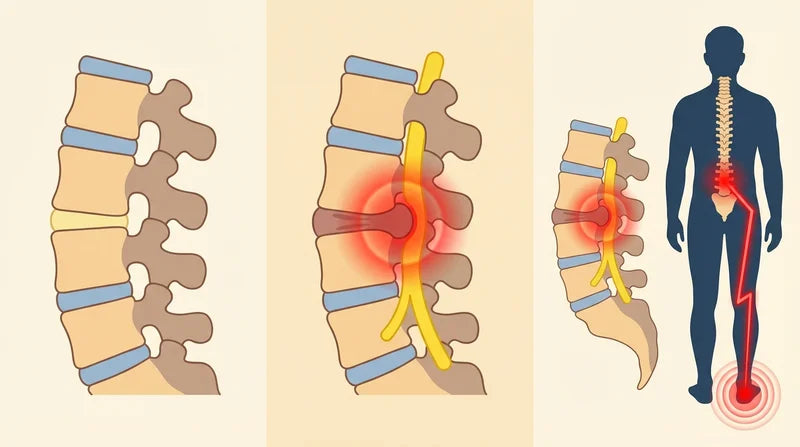
Your spine is curving. Slowly. To one side. And every year, a little more.
Your spine is a stack of bones with a cushion between each one. Those cushions are your discs. They absorb shock. They keep the bones apart.
After 50, they don't wear evenly. One side goes flat. The other side still has some give.
So the bone above tilts. Toward the flat side.
And here's the part nobody tells you. The tilt puts more weight on the flat side. More weight flattens it faster. Which tilts the bone more. Which puts more weight on the flat side.
It's a cycle that accelerates every year.
One side of each cushion wears thinner. The bone shifts. The muscles on the short side work double to keep you upright. They fatigue. They spasm. They give out. And the curve gets a little bit worse.
No exercise will re-inflate a flattened cushion. No stretch will level a tilted bone. No painkiller will stop the cycle.
That's why nothing you've tried has lasted more than a day or two. You've been treating the muscles. The problem is the cushion.
Three Things at the Same Time
The research was clear. To slow the curve and hold the spine straighter, three things have to happen at the same time:
DECOMPRESS. Take the load off the compressed side of the spine. Give the vertebrae room to shift back toward the centre.
HEAT. Bring warmth and blood flow to the tight, overworked muscles on the concave side. So they can finally relax.
RELEASE. Work the muscle bands that are pulling the spine sideways. Break the tension that's reinforcing the curve.
This isn't alternative medicine. It's what the official medical guidelines say you should try first for long-term back pain. Before pills. Before injections. Before surgery.
Your physiotherapist knows this. So does your chiropractor. They just deliver these three steps across separate appointments. At £55 each. And by the time your NHS referral finally comes through, the curve has progressed another degree.
The Device
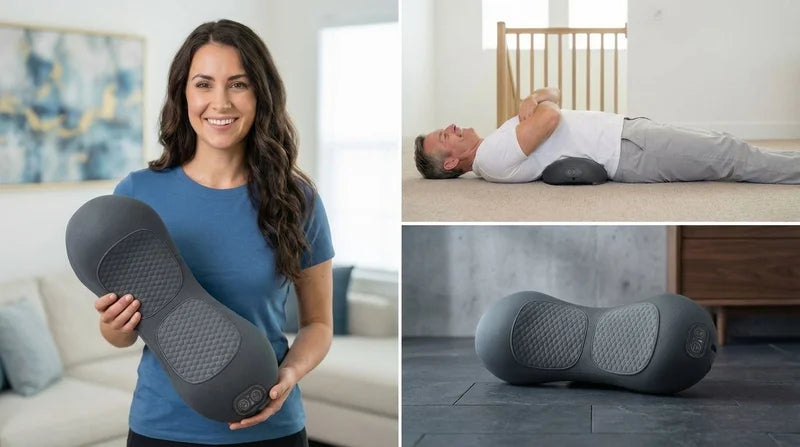
It's called the Back Massager Pro.
It's the only home device I've found that delivers all three steps in a single session. Fifteen minutes. Every day. At home.
DECOMPRESSION. Gently stretches and lifts the spine. Equalises pressure across both sides. Creates the space the compressed discs need to recover.
DEEP HEAT. Warmth that penetrates deep into the tight side of the lower back. Gets the blood flowing. Helps relax the muscles that have been working double shifts for years.
TARGETED MASSAGE. Works the muscle bands pulling the spine into its curve. Loosens them so they stop reinforcing the tilt.
All three. Automatic. You lie down, press one button, and let it run.
What Happened When I Tried It
I didn't believe it at first. Of course not. I've spent my career using my hands. The idea that a device could do what I do felt like a joke.
But my spine was curving. My wife had started reaching for my arm like I might lean further. And I'd just watched my son hold me upright for a wedding photo.
So I tried it.
Day one. A warm, stretching sensation. Pleasant. Nothing remarkable.
Day four. Standing in the kitchen. Petra looked at me. "You're not leaning." I wasn't. For the first time in three years, I was standing without compensating. Without shifting my weight to counterbalance the tilt. If you've lived with scoliosis, you know what that sentence means.
Day seven. Bathroom mirror. I still leaned. But less. The shoulder gap had closed by maybe half an inch. I stood there staring. Petra came in. "Your shirt sits better," she said.
Day fourteen. Dinner at Petra's sister's. Sat at the table for two hours. When I stood up, I stood up straight. No grab for the chair. No hitch. Petra's sister said, "Robert, you look taller." I wasn't taller. I was just not shrinking sideways any more.
That's when I knew this wasn't placebo.
The 15-Minute Protocol
Minutes 0 to 5: Decompress
The device gently lifts and stretches the lower back, equalising pressure across both sides. The compressed side gets room to expand. Most people feel something release within the first few minutes. That's years of one-sided loading finally letting go.
Minutes 5 to 10: Heat
Deep warmth penetrates into the muscles on the tight side. The concave side. The side that's been overworking for years. Blood flow increases. The spasm that holds the curve starts to soften.
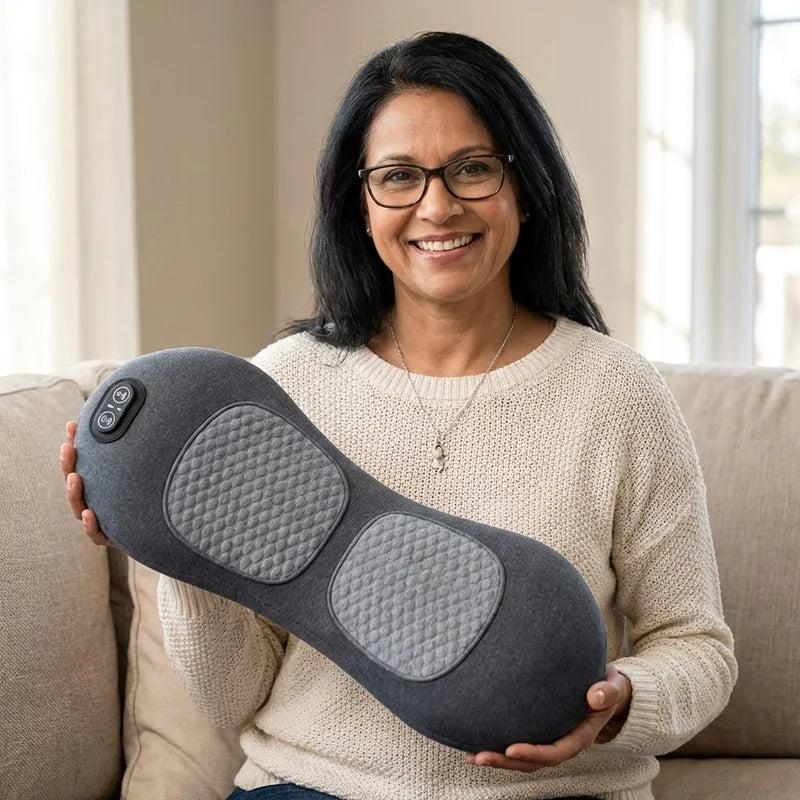
Minutes 10 to 15: Release
Targeted massage works the deep muscle bands around the spine. The ones pulling it sideways. They loosen. They let go. And for the first time, the spine can sit closer to centre.
Fifteen minutes. Then you stand up and feel the difference.
The Numbers
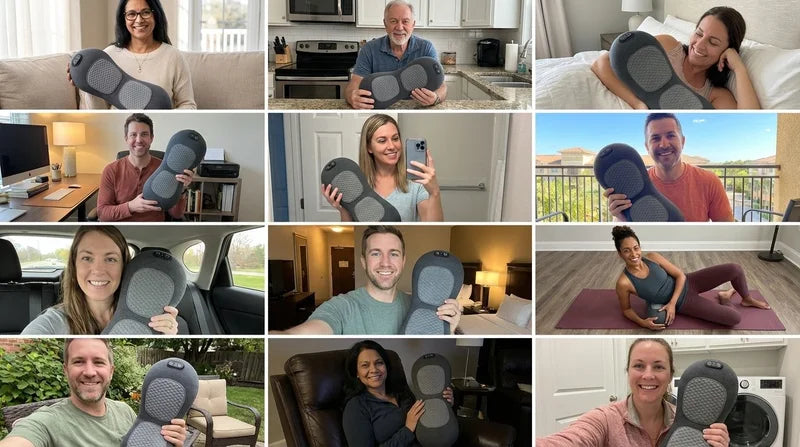
Over 24,000 people have used the Back Massager Pro in the last 18 months.
✓ 87% report noticeable relief within 2 weeks
✓ 2 out of 3 stopped their regular treatment sessions within a month
✓ Fewer than 2 in 100 send it back
Return rate: 1.1%. Meaning 98.9% keep it.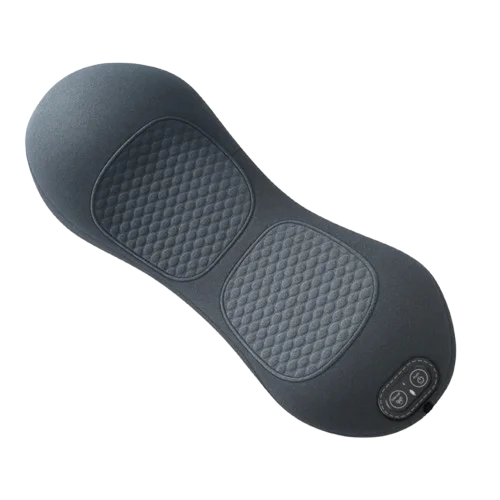
The Mechanism: The 15-Minute Spinal Realignment Protocol
Why this works where everything you've already tried didn't.It's not a new discovery. It's a daily protocol in three phases that brings together the approaches clinical guidelines recommend first for postural and curvature-related back pain. Finally together. Every day. On your own, you might manage one of these phases, occasionally. The 15-Minute Spinal Realignment Protocol simply runs all three in sequence. 15 minutes. The regularity that was always the missing piece:
Gentle Decompression
Cradles the lower back and equalises pressure across both sides. Takes the load off the compressed side so the vertebrae can begin to realign.
Deep Heat
Warmth that penetrates beneath the surface, encouraging blood flow to the overworked muscles on the concave side. Helping them finally relax.
Precision Massage
Works the muscle bands pulling the spine sideways. Where the tension actually lives. So they let go and stop reinforcing the curve.
Only 941 units left at the launch price. Check today's availability & 30-day trial ↓
Check Availability →30-day risk-free trial · Free UK shippingThis is not a fringe method. Here is what the research actually says
The methods behind these phases are not guesswork from alternative medicine. They are the non-pharmaceutical foundations that clinical research consistently supports for postural and curvature-related conditions. Here is where the evidence is solid, and where it is modest:
- Heat therapy. A Cochrane review found that heat application provides short-term relief of pain and disability in the lower back, with stronger effects when combined with gentle movement.1
- Massage. A Cochrane review found that massage improved pain and function for lower-back pain in the short term (low-certainty evidence, and we won't overstate it).2
- Guideline-supported. Major medical guidelines, including those from the American College of Physicians, list heat, massage, and exercise among the approaches to try first, before medication.3
- Decompression. A 2022 randomised trial found that non-surgical decompression added to physiotherapy improved pain, range of motion, and function after 4 weeks more than physiotherapy alone. In a clinical setting, with 60 patients.4
The honest side: these studies describe the methods (heat, massage, decompression), not this specific device, and the effects are generally modest and short-lived on their own. That's exactly why doing all of them, daily, matters. None of this is a cure.
Let me be honest with you
- This is not a medical device, and I'm not pretending it is. It's a daily ritual. 15 minutes that gives your back the decompression, heat, and release it's been begging for. No appointment. No NHS waiting list. No £55 invoice.
- It won't replace your doctor if you need one. But for the 8 out of 10 people whose back pain is postural, curvature-related, and muscular? This is exactly what the clinical guidelines say to try first. Before pills, before injections, before surgery.
- Most people notice something within the first few sessions. For some it's immediate. For others it builds. That's why you get 30 full days to decide. Not 7. Not 14. Use it every evening. If your mornings aren't different, send it back.
What Over 24,000 Users Are Saying
"Last week I put on a dress shirt for my daughter's engagement dinner. It sat level across both shoulders. No bunching on the left side. No pulling down on the right. I haven't been able to button a shirt and have it sit straight in four years. My wife ironed it and then just stared at me. 'It finally hangs right,' she said. A shirt. That's what made me cry."
"I can stand in a queue at the post office now. That sounds like nothing. But for three years I couldn't stand for more than two minutes without leaning on something. A wall, a trolley, my husband's arm. Last Tuesday I stood in line for eleven minutes. Straight. No leaning. The woman behind me wouldn't have noticed. But I noticed."
"My brother saw me at Christmas for the first time in a year. First thing he said: 'You look taller.' I'm not taller. I'm just not tilting any more. My left shoulder used to sit an inch higher than my right. Three months with this thing, every morning, and the gap has almost closed. My wife takes photos now to track it. Says I look like myself again."
If your back is quietly running your days, here's what I'd say if you were sitting in my clinic right now: just try it. You have 30 days. It costs you nothing to find out. Use it every evening and see how your mornings feel after two weeks. That's not a sales pitch. That's what I wish someone had told me before my son had to hold me straight for the wedding photos.
What You're Actually Paying. Let's Compare
Chiropractor:
2x per week, 6 months = 48 sessions · £55 per session = £2,640
(And you still have to keep going)
Physiotherapy clinic:
Consultation + scans + manual therapy = £1,300 to £2,100
(Helps for a while. Then it comes back)
Posture brace:
£170 to £420
(Uncomfortable. Doesn't address the cause. Just holds you in place until you take it off.)
The Back Massager Pro:
£106. Once. Yours to keep.
That's less than two physio sessions. For something you use every day, at home, for years.
⬤ Limited Batch. 60% Off
Normal price
£265
£106
Only 941 units left at this price
Order Now. 60% Off →Free UK shipping · 30-day money-back guaranteeWhen they're gone, the price returns to £265
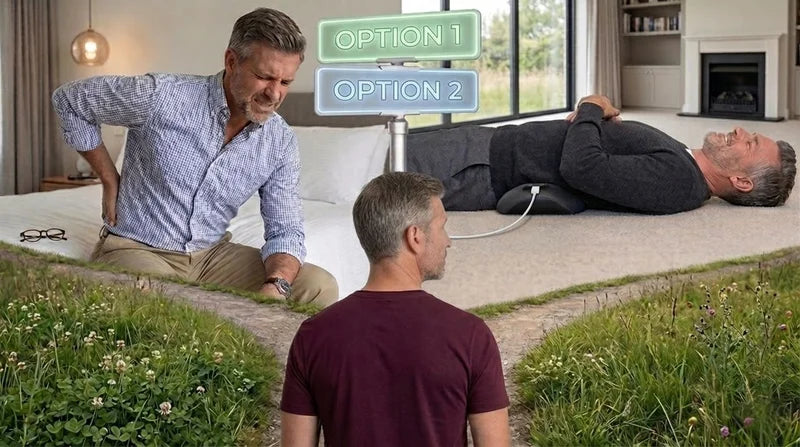
You Have Two Options. Be Honest About Which One You're Choosing.
Option A: Keep managing it
Another year of appointments. Another year of watching your shoulder climb a little higher. Another year of avoiding cameras and catching your reflection and looking away. In twelve months you'll have spent another £1,700 and the curve will be a little worse.
Option B: Try this for 30 days
For less than two physio sessions, you get what over 24,000 people already use every day. 15 minutes. At home. If your back isn't noticeably straighter after 30 days, send it back and pay nothing. If it is, you just took your posture back for £106.
I know which one I'd pick. I know because I spent three years and £14,700 on Option A before I tried this.
What to Do Right Now
- Tap the green button below.
- Choose your package. If your partner has the same problem, you can order one for them too.
- Enter your details. Orders before the afternoon cut-off ship the same day.
- Use it for 15 minutes the evening it arrives. Lie back. Breathe. Stand up and notice.
- Use it every day for 30 days. If your back isn't straighter, send it back. No cost. No hassle.
Don't bookmark this page and tell yourself you'll come back to it.
I told myself "next month" for three years. Next month I'll try something different. Next month I'll look into it. Next month.
Next month is how you end up with your son holding you straight for the wedding photos.
Only 941 units left at the launch price. Check today's availability & 30-day trial ↓
Check Availability →30-day risk-free trial · Free UK shipping
Robert Steiner · Physiotherapist · Body Insights
19 years in clinical practice. Spent £14,700 on his own spine before admitting the treatments he was giving patients weren't working for him either. Danced with his wife at a party last month. Standing. Not leaning. First time in three years. Their son was there. He didn't look away.
DAYS
Try it for 30 days. On us.
Use it every day for a month. If your back doesn't feel noticeably better, send it back and receive a full refund. Keep nothing, owe nothing. 98.9% of daily users keep it.
Quick Questions
Does it help with my specific condition (adult scoliosis, herniated disc, sciatica, spinal stenosis)?
The Back Massager Pro is designed for general chronic lower-back discomfort in adults. Many users with conditions like adult scoliosis, herniated discs and sciatica report relief, but individual results vary. If you have a diagnosed spinal condition, consult your doctor before use. The 30-day guarantee lets you try it risk-free regardless.
How long do I need to use it each day?
Just 15 minutes. The three-phase protocol runs automatically. Most people use it once daily; some prefer a morning and evening session. There is no need to exceed 15 minutes per session.
Who should NOT use it?
Do not use if you are pregnant, have had recent spinal surgery (within 6 months), have spinal fractures, or have an active spinal infection. If in doubt, ask your doctor first.
How fast is shipping?
Orders placed before the afternoon cut-off ship the same day. Free UK shipping from our local warehouse, with standard delivery in 3-5 business days. Tracking is included with every order.
What if it doesn't work for me?
Send it back within 30 days for a full refund. No forms, no hassle. 98.9% of buyers keep it. But the guarantee is there so you risk nothing.
PS. Last month, Petra and I went to a friend's 25th anniversary party. There was a band. Our song came on. I looked at her. She started to shake her head. Force of habit. Then she stopped. I took her hand. We danced. Not perfectly straight. My left shoulder still sits a little high. But I wasn't leaning on her. For the first time in three years, she held my hand to dance. Not to hold me up. Daniel was there. He didn't look away this time.
PPS. The 30-day guarantee means you risk nothing. Use it every day for a month. If your back isn't noticeably straighter, send it back. Full refund. £106 back in your account. I can offer this because 98.9% of people keep it.
PPPS. The launch price of £106 is temporary. Only 941 units remain at this price. When they're gone, it goes back to £265. If you're reading this and the button below still works, the offer is still live.
Sources
- French SD, et al. Superficial heat or cold for low back pain. Cochrane Database Syst Rev. 2006;(1):CD004750. cochranelibrary.com
- Furlan AD, et al. Massage for low-back pain. Cochrane Database Syst Rev. 2015;(9):CD001929. cochranelibrary.com
- Qaseem A, et al. Noninvasive Treatments for Acute, Subacute, and Chronic Low Back Pain: A Clinical Practice Guideline From the American College of Physicians. Ann Intern Med. 2017;166(7):514–530. acpjournals.org
- Amjad F, et al. Effects of non-surgical decompression therapy in addition to routine physical therapy … in patients with lumbar radiculopathy: a randomized controlled trial. BMC Musculoskelet Disord. 2022;23:255. biomedcentral.com
- Negrini A, et al. Scoliosis-Specific exercises can reduce the progression of severe curves in adult idiopathic scoliosis: a long-term cohort study. Scoliosis. 2015;10:20. biomedcentral.com
The RelieveMotion Back Massager Pro is a wellness and muscle-relaxation device for temporary relief of everyday muscle tension and support of well-being and mobility. It is not a medical device and is not intended to diagnose, treat, cure, or prevent any disease. The studies cited describe the general methods (heat, massage, decompression), not this specific device. If you have a diagnosed condition or warning symptoms, consult your doctor. Individual results vary.