
At 52, I’d Tried Everything. The Thing That Finally Worked Wasn’t in Any Doctor’s Office, and Nobody Had a Reason to Tell Me.
Eighteen months. Four physios, two chiropractors, a surgeon with his hand already out. Every one of them helped for about a minute. Not one of them ever told me the truth: I wasn’t failing at getting better. I was being handed the right things one at a time, weeks apart, so they could never add up to anything.
The surgeon looked at my scan for four seconds. Then he reached across the desk to shake my hand.
Four seconds. Maybe five. “We can go in and tidy up the disc that’s pressing on things,” he said. “Whenever you’re ready.” And then the handshake, as if we’d agreed on something. He wasn’t cruel. He was busy, and certain, and already half thinking about his next patient. It was only out in the car park that the second penny dropped. That handshake wasn’t for me. The operation he’d just floated cost about the same as a brand-new car, and as far as his practice was concerned, one had just driven itself into the waiting room.
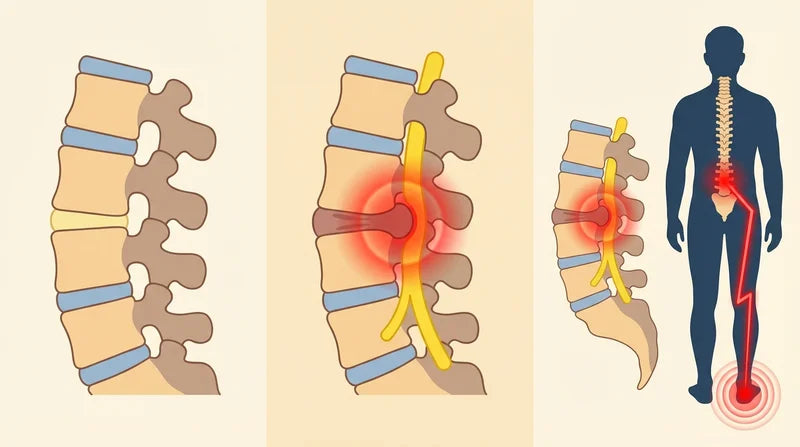
I sat in that car and cried, and for once it wasn’t the pain. It was the realisation that after a year and a half, the only door anyone had left open for me had the word “surgery” written on it. And I was terrified of that door, because I’d watched it before. Eleven years ago my own mother went into that same operation walking with a cane. She came out needing a wheelchair. Now, surgeons will tell you, truthfully, that it usually goes far better than that, and I believe them. But when it’s your mother in the chair, “usually” stops being a word that comforts anybody.
If you’ve ever sat in your own car after one of these appointments and felt the entire system quietly close its file on you, then you already know exactly how I felt. And you can probably guess how long the road behind me had to be to dump me there.
“I’ve tried everything” isn’t a turn of phrase for me. I have the folder to prove it.
Eighteen months. Four physiotherapists. Two chiropractors. A pain specialist who barely looked up from his screen. There is a fat blue folder at home, stuffed with referral letters and scan results, and every page says, more or less, the same expensive nothing.
It started as a dull ache on one side of my backside, and I ignored it, the way you do. By spring it was a hot electric wire running from my hip to my calf, and ignoring it was no longer on the menu. The cinema was out. Any car journey over twenty minutes ended with me needing both hands and the door frame just to lever myself out the other end. I owned a cushion for every room in the house. Not one of them helped. I just owned a lot of cushions.
And here is the part I’m not proud of. The longer it dragged on, the more I quietly decided it was my own fault. I wasn’t stretching enough. Wasn’t strong enough. Wasn’t “staying on top of it,” whatever that meant. I stopped saying yes to things. I missed my best friend’s sixtieth because I couldn’t face the chairs. I turned into a hermit in my own life. And somewhere in there, without ever once deciding it, I made my peace with the idea that this smaller, more careful, more apologetic woman was simply who I was now. At fifty-two.
Every single thing helped for a minute. Then it took the money and left.
Physiotherapy first. Months of it. Each new physio started me almost from scratch, and each one, in the end, gently told me to “keep the exercises up at home.” Then the chiropractor, with the dramatic cracks and the hopeful noises and the relief that lasted about as long as the drive home. I went back eleven times. Eleven. Then the injections. A nerve block that bought me two genuinely lovely weeks and then quietly stopped working, and the moment I hesitated about a second one, that was when the word “surgery” first drifted into the room.
It took me eighteen months and a stranger on the internet to see the thing that should have been obvious on day one. Look at that list honestly. Every single thing I tried was a one-off. A visit. A session. A shot. Something done to me, every now and again, by somebody who got paid each time I came back. And then nothing. Day after day of nothing, until the next appointment finally came round and I handed over more money to feel briefly less broken.
The thing that finally explained it wasn’t in any of those rooms
Two in the morning. The leg buzzing the way it did most nights, me scrolling because I’d given up on sleep. I ended up in the comments under some video, and a total stranger had typed a few sentences that did what eighteen months of specialists somehow hadn’t. They explained why.
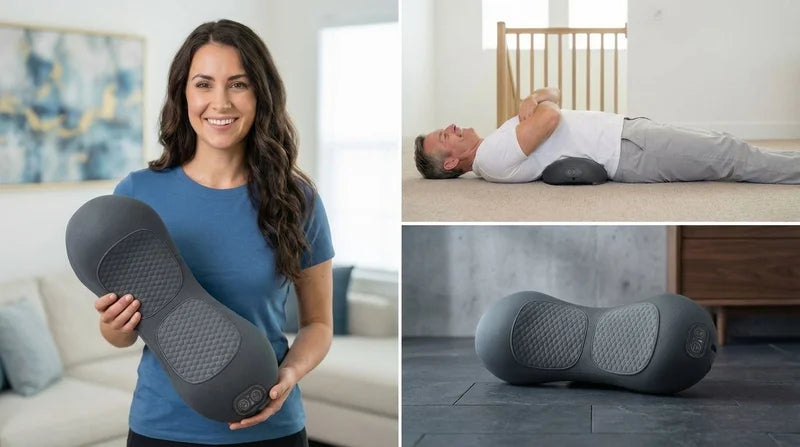
The things that genuinely calm an angry lower back, this person wrote, and the nerve pain it fires down your leg, are not exotic. There are four of them, and they work as a sequence. Gentle decompression, to take the load off. Warmth, to coax the area to settle. Massage, to get the muscles clamped around the nerve to finally let go. And then more sustained warmth, to hold all of it open long enough to count. The plain, drug-free basics good clinicians reach for first. And there’s real research behind doing them, including a trial where adding gentle, non-surgical decompression to ordinary physiotherapy beat the physiotherapy on its own, for exactly this back-into-the-leg kind of pain. (I read that part four times. The honest, measured version of it is further down this page.)
It was the decompression part that finally made my own scan make sense. My surgeon had said it himself, almost in passing: a disc “pressing on things.” Those discs are meant to be plump, fluid-filled cushions that hold the bones of your spine apart and keep a clear channel for the nerves. Squash one flat under years of sitting and load and it bulges and presses exactly where it shouldn’t, straight onto the nerve. Gentle decompression does the opposite of a long day spent crushing it. It eases the bones apart, lifts the load off that flattened disc, and gives the nerve a little of its room back. In eighteen months of specialists, not one had ever put it to me that plainly. Why would they? Plain explanations don’t book follow-ups.
“So why doesn’t it work for most people?” the stranger had written. “Because you can’t do all four of them, properly, every day, on your own. You manage one, sometimes. The physio does the massage on a Tuesday. You do the stretches until Thursday. The heat pad lives in a drawer. You never once get all four on the same day, which is the only version that adds up to anything.”
I sat in the dark and read it twice. It was the first time in eighteen months that anything about my own back had made plain, furious sense.
What changed it, and what I very nearly did instead
That stranger, in a few lines at two in the morning, handed me the thing eighteen months of appointments never did. Not another room to sit in. Not another routine to abandon by Thursday. The exact opposite of an appointment: something that would do the work for me, at home, on the precise days I would never once have managed it myself. That, and nothing cleverer than that, is the entire reason the Back Massager Pro exists.
It isn’t a gadget with a hundred buttons. You lie back on it and the contoured ridge draws your lower spine long, that involuntary ahhh of a stretch, while a pair of rollers work slowly up and down the muscle either side of the spine and a low, steady heat sinks through the whole area and holds it loose. Decompression, warmth, massage, and a warm hold to lock it in. The four things the clinic charges you by the hour for, all at once, for fifteen minutes, on your own living-room floor. You pick the strength, you breathe, you get up looser than you lay down. No waiting room. No referral letter. Nobody reaching across a desk to shake your hand.
I’ll tell you what happened plainly, because the plain version beats any sales pitch. The first time I drove two hours up to my grandchildren, I got out at the far end and walked up the path. No door frame. No bracing. No halfway stop with the hazard lights on. I didn’t even notice I’d done it until my daughter, watching from the step, asked when I’d quietly stopped doing “the door-frame thing.” I sat in her driveway and cried about that one. Happy tears, for the first time in years. A few weeks later the cushions went back in the cupboard, one room at a time. I didn’t decide to put them away. I just stopped reaching for them.
I still have the folder. The fat blue one. I keep it to remind myself how long that road was, and that the thing which finally turned it around was in none of those appointments. I haven’t ruled surgery out, for the record. My surgeon is still there if I ever truly need him. But before I sign up for something I can’t undo, priced like a new car, I’m giving the simple daily version a proper go first. When that’s the choice on the table, this just feels like common sense.
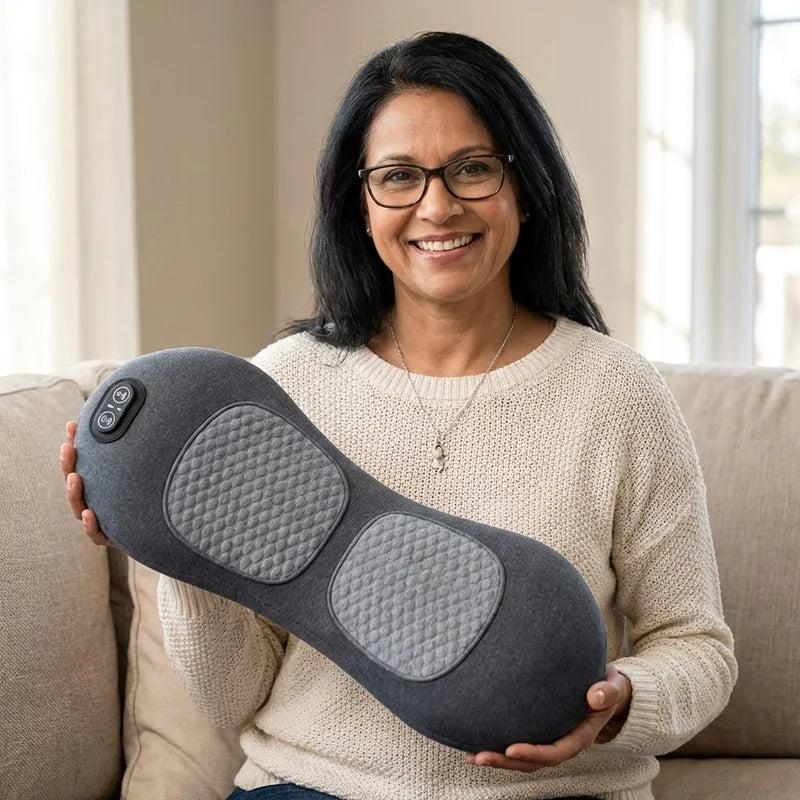
So let me say the thing I wish my own sister, or anyone, had said to me eighteen months ago. You have already survived the hard part. The years of it. The appointments. The folder full of nothing. This, lying back for fifteen minutes a day, is the easy part, and God knows you’ve earned it.
Here is exactly what those fifteen minutes are.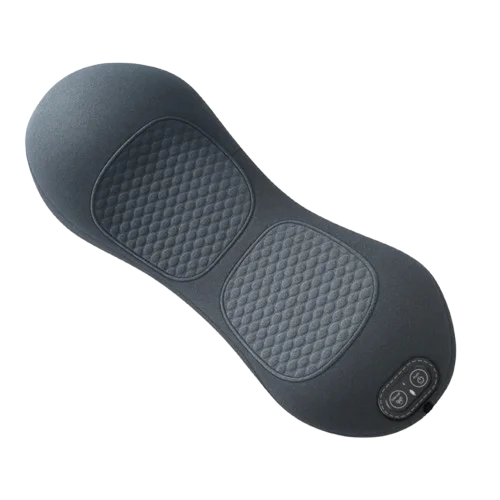
The mechanism: The 15-Minute Spinal Restoration Protocol
Why this works when the things you’ve already tried didn’t.It’s not a new discovery, it’s the plain, drug-free basics good clinicians reach for first, decompression, massage and heat, finally run as one four-phase cycle, every single day. On your own you manage one of them, occasionally. The 15-Minute Spinal Restoration Protocol is simply all four at once, for 15 minutes, the consistency that was always the missing piece:
Gentle Decompression
Cradles & lengthens the lower back, that long "ahhh" stretch that eases pressure off the area.
Targeted Massage
Works the bands of muscle either side of the spine, where the tension actually lives.
Soothing Heat
Warms it all so the clamped muscles soften and begin to let go.
Thermal Hold
Keeps the warmth steady so the release lasts, instead of vanishing the moment you stand up.
Stop renting relief by the appointment. Check today’s availability & 30-day trial ↓
Check Availability →30-day try-it-yourself guarantee · free shippingThis isn't fringe. Here's what the evidence actually says
The methods behind these phases aren't alternative-medicine guesswork. They're the drug-free basics the research keeps pointing back to. Here's where that evidence is solid, and where it's modest:
- Heat. A Cochrane review found heat-wrap therapy gives a small, short-term reduction in low-back pain and disability, more so with gentle movement added.1
- Massage. A Cochrane review found massage improved pain and function in the short term for low-back pain (low-certainty evidence, we won't oversell it).2
- Guideline-backed. Major physician guidelines, including the American College of Physicians, list heat, massage and exercise among the options to try first, before drugs.3
- Decompression. A 2022 randomized trial found adding non-surgical decompression to physiotherapy improved pain, movement and function more than physiotherapy alone at 4 weeks, in a clinic, with 60 patients.4
The honest part: these studies are about the methods, heat, massage, decompression, not this specific device, and the effects are generally modest and short-lived. That's exactly why doing them all, daily, is the point. None of it is a cure.
Let's be straight with you
- It will not rebuild your spine, "reverse" a diagnosis, or replace medical care. Nothing you lie on can.
- What it does: gives tight, overworked back muscles a daily chance to decompress, release and relax, so life stops revolving around your back.
- Results vary. Some feel it the first session; for others it builds over a week or two of daily use. That's what the 30 days are for.
What customers tell us
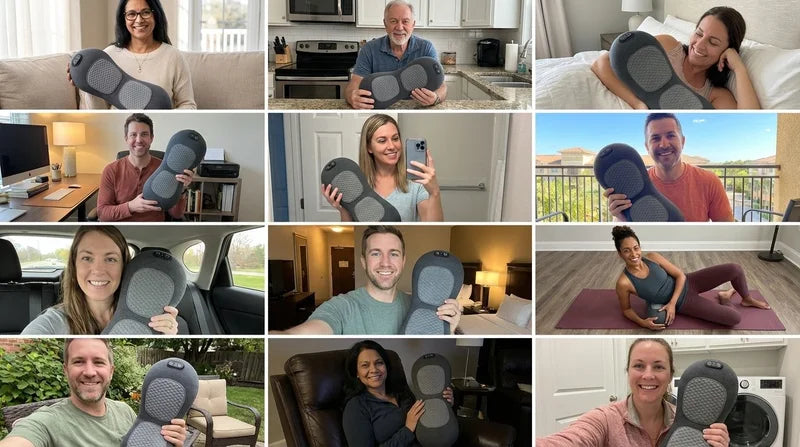
"After 30 days with it, my check-up showed clear progress. My surgeon was surprised and told me: whatever you’re doing, keep doing it. I haven’t needed further treatment since."
"Because of collapsed vertebrae I could barely walk. I started using it out of sheer desperation. After a few weeks I noticed more and more difference, and I can go for walks again, which means everything to me."
"I was taking pills every day just to get through. After three weeks, in consultation with my doctor, I was able to stop completely. My liver’s grateful and my wallet too, but most of all, I feel like myself again."
If your back has been quietly running your days, here’s the honest, no-pressure version: I’d just try it. There’s a 30-day window where it costs you nothing to find out, and you keep using it the whole time to decide. That’s genuinely how I’d tell a friend to approach it, not “buy this,” just “give it the two weeks and see.”
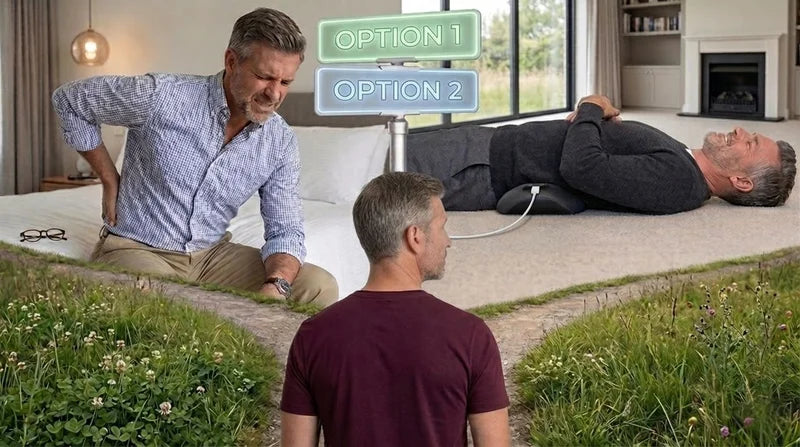
So here’s your actual choice. Be honest about which one you’re living.
Keep doing exactly what you’re doing
Keep paying someone to crack your back twice a month for relief that’s gone by the drive home. Keep rattling the pill bottle. Keep sleeping in that one weird position. Keep saying “maybe next time” to the people you love. Keep being a subscription to an industry that gets paid whether you get better or not. A year from now your back will be exactly this sore, and your folder will be exactly this fat.
Or give your back the four things it’s been begging for
Fifteen minutes a day, at home, for less than the price of a single specialist visit. The decompression, the warmth, the massage, the hold, every day, the version that finally adds up. Thirty days to feel it, on a full money-back guarantee. The worst case is you post it back and you’re out nothing. Read that again, because the people who profit from your pain are praying you don’t.
I know which one I’d pick. I know because I wasted eighteen months picking the other one.
Here’s exactly what to do next
- Tap the button that says “Check Availability.”
- Choose your package. If your partner’s back is going too, get two now, you’ll never split one peacefully.
- Put in your details. Orders before the afternoon cut-off ship the same day.
- Use it for fifteen minutes the moment it lands. Lie back, breathe, get up looser.
- Do it every day for thirty days. If your back isn’t meaningfully looser, send it back and pay nothing.
Do not close this page telling yourself “later.” I told myself “later” for eighteen months. Later is another night on the bathroom floor. Later is another family lunch you watch from the good chair. Later is the most expensive word in this whole story.
Stop renting relief by the appointment. Check today’s availability & 30-day trial ↓
Check Availability →30-day try-it-yourself guarantee · free shippingDAYS
Try it for 30 days. On us.
Use it daily for one month. If your back doesn't feel meaningfully better, send it back for a full refund. Keep nothing, owe nothing. Most people who use it daily keep it.
Quick questions
How fast will I notice anything?
Some people feel a difference the first session. For many it builds over 1–2 weeks of daily 15-minute use. The 30-day guarantee exists so you can find out without risk.
Is it hard to set up or use?
No. Place it on the floor, bed or couch, lie back, pick your intensity and heat, breathe for 15 minutes. It ships ready to use.
Can my partner use it too?
Yes, it isn't personalised to one body. Share it freely.
What if it doesn't work for me?
Send it back within 30 days for a full refund. Keep using it the whole time to decide.
P.S. The first time I drove the two hours to the grandchildren without the leg lighting up at the halfway mark, I didn’t notice until I was turning into their road. I’d simply forgotten to brace. I cannot describe to you what it is to forget to brace.
P.P.S. My daughter asked me when I’d stopped doing “the door-frame thing.” I realised I hadn’t done it in weeks. I’ll be honest with you about the deal, because it’s the only reason I’ll put my name to any of this: thirty days, every day, and if you’re not meaningfully looser you send it back and you’re out nothing. It is not a cure and I would never insult you by calling it one. It is the four simple things, finally done every day. That was always the only part I’d been getting wrong.
Sources
- French SD, et al. Superficial heat or cold for low back pain. Cochrane Database Syst Rev. 2006;(1):CD004750. cochranelibrary.com
- Furlan AD, et al. Massage for low-back pain. Cochrane Database Syst Rev. 2015;(9):CD001929. cochranelibrary.com
- Qaseem A, et al. Noninvasive Treatments for Acute, Subacute, and Chronic Low Back Pain: A Clinical Practice Guideline From the American College of Physicians. Ann Intern Med. 2017;166(7):514–530. acpjournals.org
- Amjad F, et al. Effects of non-surgical decompression therapy in addition to routine physical therapy … in patients with lumbar radiculopathy: a randomized controlled trial. BMC Musculoskelet Disord. 2022;23:255. biomedcentral.com
RelieveMotion Back Massager Pro is a wellness and muscle-relief device intended for the temporary relief of everyday muscle tension and to support comfort and mobility. It is not a medical device and is not intended to diagnose, treat, cure or prevent any disease. Cited studies describe the general methods (heat, massage, decompression), not this specific device. If you have a diagnosed condition or red-flag symptoms, consult your doctor. Individual results vary.