
My Little Girl Lifted Her Arms to Be Picked Up. I Turned to the Sink and Pretended I Was Busy. Two Years Later I Found Out It Was Never My Fault.
I got frighteningly good at faking fine. What nobody told me, not one of the people I paid, was that the one thing actually helping my back was the single thing a busy mother can never keep up on her own. They were happy to let me believe I was the problem.
My daughter ran in from the garden, threw both arms up at me, and shouted “up, Mommy.” And I turned to the dishwasher and pretended to be busy, so she would give up and go to her dad instead.
She was three. She just wanted picking up. And I stood at that sink with my back to her so she could not see my face, because the truth was I could not do it. Not without lowering myself like I was made of glass. Not without paying for it in pain for the rest of the day.
I was thirty-eight years old, and I could not pick up my own child. Sit with that, because I had to.
If you have ever turned away from your own kid to hide what your body will not do anymore, then you already know this is not really about a sore back. It is about who the pain is quietly turning you into, in front of the only people who matter. And it is about an industry that is perfectly content to let that keep happening, one appointment at a time.
I became an expert at faking fine. It is the loneliest skill I have ever learned.
I learned to lower myself to the floor as if I had chosen to sit down there. I learned to keep talking and laughing while one hand quietly found the edge of the counter to push myself back up. To everyone watching, my husband, my friends, the other mothers at the gates, I was coping. Managing. Fine.
Inside I felt like a hollowed-out version of the woman I used to be, and I was ashamed of her. What kind of mother cannot lift her own daughter? What kind of thirty-eight-year-old needs both hands and a deep breath to get up off a carpet? So I said nothing, and I smiled, and I shrank. I turned down the park, the soft play, the swimming pool, with a different small lie each time, until “no” had quietly become my reflex, and my little girl simply stopped asking.
That is the part that still winds me. She did not cry about it. She did not make a scene. She just learned, at three years old, that Mommy does not pick you up. And she adjusted. Children are heartbreakingly good at adjusting to less.
I tried to fix it properly. Three times over. Each one took my money and left.
Do not for one second picture a woman who sat back and let this happen. Physiotherapy first. Weeks of exercises on a mat while my daughter rode my back like a fairground pony. Done twice a day, said the sheet. The sheet had clearly never met a toddler. The deep ache did not budge.
Then I threw money at my sleep. A new mattress we could not really afford. A tower of pillows arranged like scaffolding. A few nights flat on the bedroom floor because a stranger online swore by it. I woke up just as stiff and twice as tired.
Then the painkillers. The ones that dull the edge just enough to function and leave you foggy enough that you are never quite all there at bath time. I never wanted to be a slightly medicated mother. But there I was, every evening, telling myself it was temporary.
When I finally dragged myself to a doctor, I had rehearsed it in the car like a speech. I got three sentences out before she was already nodding. “It is very common after having children,” she said. “Most likely muscular. Try to stay active, and keep your weight down.” That was the appointment. Four minutes. I drove home, shut the bathroom door so my daughter would not hear, and cried on the edge of the tub. I had just been told, in so many words, that disappearing as a mother was normal, and that I should walk it off.
It was another mother, not a single professional I paid, who finally told me the truth
We were in one of those deafening indoor play centres. She watched me lower onto the bench like it might bite, and she had the look of a woman who had lived the exact same thing. What she said was so simple I made her say it twice.
“Everything you are doing treats it once,” she said. “Your back needs the right things a little, every single day. And no busy mother on earth keeps that up on her own. They know that. They sell you the once anyway.”
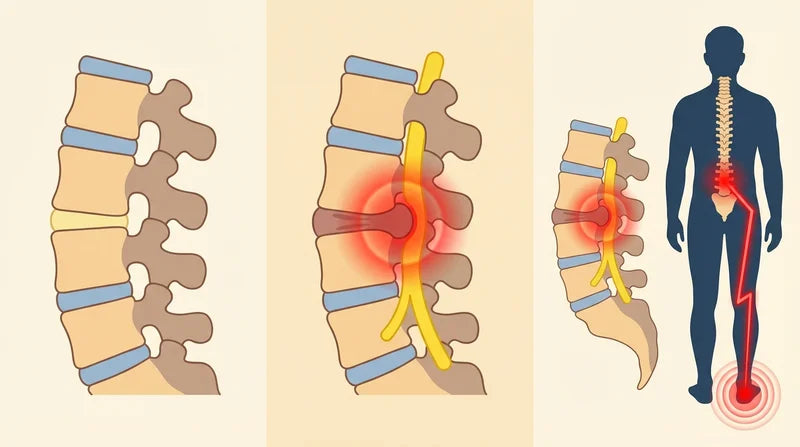
Then she explained the part not one professional had bothered to. Look at a mother’s day from her spine’s point of view. A toddler hauled onto one hip. Bent over the bath. Hunched at the stroller. Folded into the back seat wrestling a car-seat buckle. The muscles along your lower back never once clock off, so they stay clamped, overworked and tight. And underneath them, the little fluid-filled discs that cushion the bones of your spine spend the whole day being pressed flatter and squeezed of their fluid, never once getting the load lifted long enough to recover. That is why you feel jammed and crushed by evening, and why one session of anything, however good, never holds.
What actually settles it, she said, is four things, done together. Gentle decompression, to ease the bones apart and take the load off those flattened discs. Warmth, to coax the whole area to let go. Massage, to talk the clamped muscles either side of the spine into releasing. And steady heat to hold it all open long enough to count. The plain, drug-free basics a good physiotherapist starts you on. Nothing exotic. (The honest, measured version of the research behind that is further down this page.)
“But here is why it never works for people like us,” she said, nodding at the chaos. “You will manage the heat pad once. You will drop the stretches by Wednesday. And you cannot massage your own spine at nine at night with one ear on the baby monitor. So you never get the version that holds. They are not selling you a fix. They are selling you a Tuesday.”
Fifteen minutes while the kettle boils. That was the whole secret.
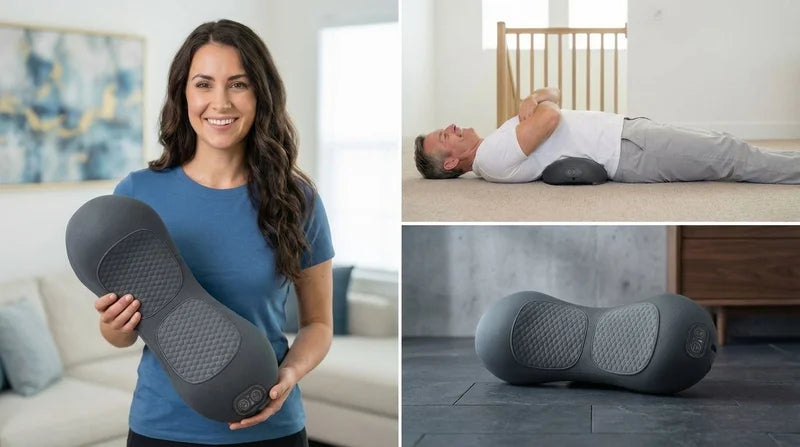
That bench conversation is the only reason the Back Massager Pro is in my house. It exists to do all four things at once, automatically, in the one window a parent can actually find. You lie back on it, on the floor or the bed, and the contoured ridge draws your lower back long, easing the day’s compression off it, while two rollers knead slowly up and down the muscle either side of the spine and a soft, steady heat sinks in and holds everything loose. You pick the strength. You breathe. Fifteen minutes, about the length of a kettle and a quiet cup of tea, and you get up looser than you lay down, and you get back to the chaos.
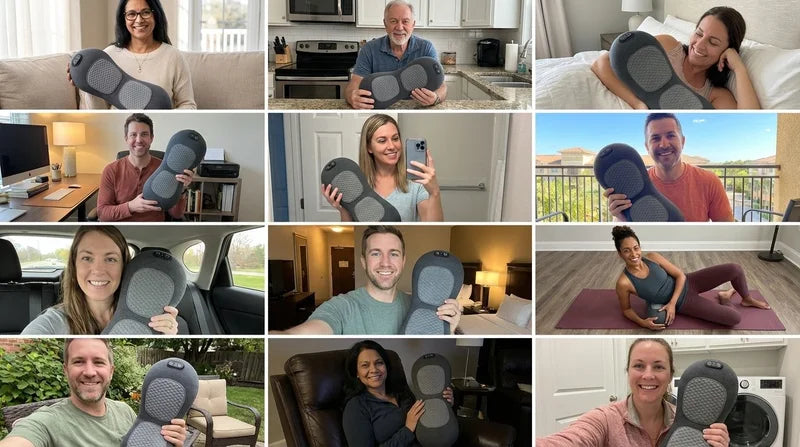
No appointment. No childcare to arrange. No willpower required after eight o’clock, which is the first thing to go anyway.
The first school run where I did not scan the playground for somewhere to sit, I did not even notice until I was driving home. By the second week, getting down to the floor for a puzzle, and back up, had stopped being a negotiation I held with myself.
But the moment that undid me was an ordinary Saturday. My daughter ran in, threw both arms up, “up, Mommy.” And without thinking, without bracing, without that cold little sum of what it would cost me later, I bent and scooped her straight onto my hip, the way I had not since she was a baby. She giggled. She had no idea anything had happened. I stood in the middle of the kitchen holding my girl and wept into her hair, and she patted my back and told me not to be sad, which made me laugh while I was still crying.
That scoop is the whole thing. The distance between the mother who turned to the dishwasher and the mother who just picks her daughter up. Fifteen minutes a day. That was the entire price of crossing it.
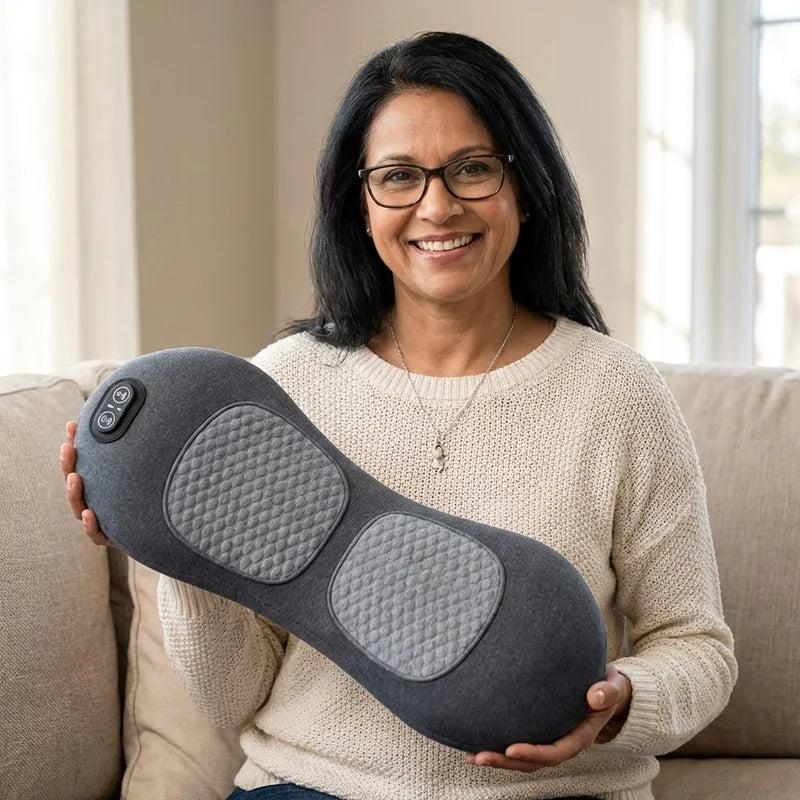
I will be straight with you, because I was the single most sceptical person in any room about gadgets like this. It is not magic and it is not a cure, and anyone who tells you different is lying to your face. Some people feel it the first session. For others it builds over a week or two of actually doing it daily, which is exactly the part the device finally makes possible. All I can tell you is what happened in this house when the right four things finally turned up every single day, instead of once in a blue moon for a fee.
Here is exactly what those fifteen minutes are.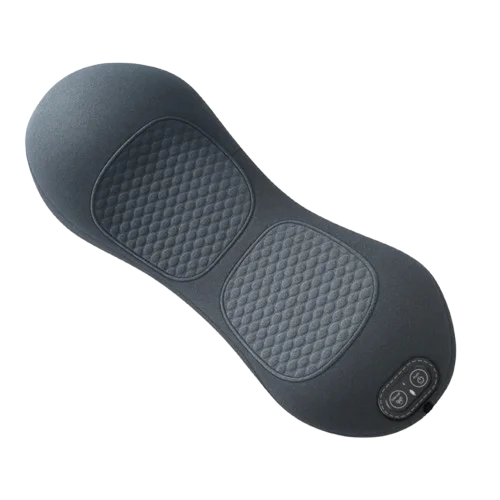
The mechanism: The 15-Minute Spinal Restoration Protocol
Why this works when the things you’ve already tried didn’t.It’s not a new discovery, it’s the plain, drug-free basics good clinicians reach for first, decompression, massage and heat, finally run as one four-phase cycle, every single day. On your own you manage one of them, occasionally. The 15-Minute Spinal Restoration Protocol is simply all four at once, for 15 minutes, the consistency that was always the missing piece:
Gentle Decompression
Cradles & lengthens the lower back, that long "ahhh" stretch that eases pressure off the area.
Targeted Massage
Works the bands of muscle either side of the spine, where the tension actually lives.
Soothing Heat
Warms it all so the clamped muscles soften and begin to let go.
Thermal Hold
Keeps the warmth steady so the release lasts, instead of vanishing the moment you stand up.
Stop turning away at the sink. Check today’s availability & 30-day trial ↓
Check Availability →30-day try-it-yourself guarantee · free shippingThis isn't fringe. Here's what the evidence actually says
The methods behind these phases aren't alternative-medicine guesswork. They're the drug-free basics the research keeps pointing back to. Here's where that evidence is solid, and where it's modest:
- Heat. A Cochrane review found heat-wrap therapy gives a small, short-term reduction in low-back pain and disability, more so with gentle movement added.1
- Massage. A Cochrane review found massage improved pain and function in the short term for low-back pain (low-certainty evidence, we won't oversell it).2
- Guideline-backed. Major physician guidelines, including the American College of Physicians, list heat, massage and exercise among the options to try first, before drugs.3
- Decompression. A 2022 randomized trial found adding non-surgical decompression to physiotherapy improved pain, movement and function more than physiotherapy alone at 4 weeks, in a clinic, with 60 patients.4
The honest part: these studies are about the methods, heat, massage, decompression, not this specific device, and the effects are generally modest and short-lived. That's exactly why doing them all, daily, is the point. None of it is a cure.
Let's be straight with you
- It will not rebuild your spine, "reverse" a diagnosis, or replace medical care. Nothing you lie on can.
- What it does: gives tight, overworked back muscles a daily chance to decompress, release and relax, so life stops revolving around your back.
- Results vary. Some feel it the first session; for others it builds over a week or two of daily use. That's what the 30 days are for.
What customers tell us
"After 30 days with it, my check-up showed clear progress. My surgeon was surprised and told me: whatever you’re doing, keep doing it. I haven’t needed further treatment since."
"Because of collapsed vertebrae I could barely walk. I started using it out of sheer desperation. After a few weeks I noticed more and more difference, and I can go for walks again, which means everything to me."
"I was taking pills every day just to get through. After three weeks, in consultation with my doctor, I was able to stop completely. My liver’s grateful and my wallet too, but most of all, I feel like myself again."
If your back has been quietly running your days, here’s the honest, no-pressure version: I’d just try it. There’s a 30-day window where it costs you nothing to find out, and you keep using it the whole time to decide. That’s genuinely how I’d tell a friend to approach it, not “buy this,” just “give it the two weeks and see.”
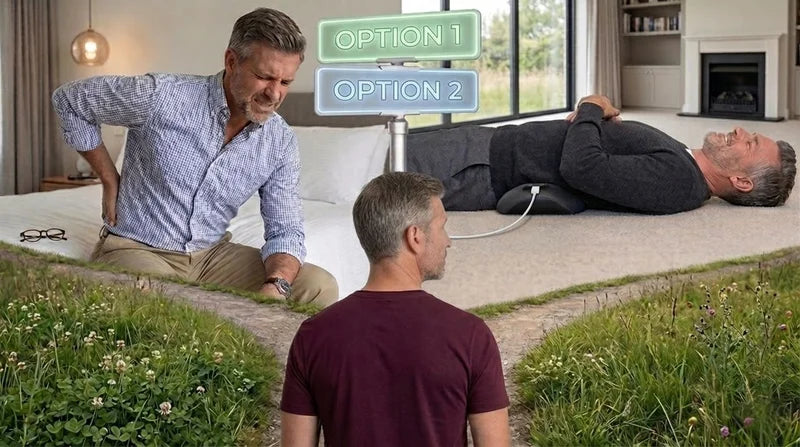
So here is your actual choice. Be honest about which one you are living.
Keep turning away at the sink
Keep lowering yourself to the floor like glass. Keep inventing reasons to skip the park. Keep the painkillers in the drawer and the fog at bath time. Keep paying people who get paid whether you get better or not. And keep letting your child learn, a little more every month, that Mommy does not pick you up. A year from now nothing will have changed except how good you have got at hiding it.
Or give your back the four things, every day
Fifteen minutes while the kettle boils, at home, for less than a single specialist visit. The decompression, the warmth, the massage, the hold, every day, the version that finally adds up. Thirty days to feel it, on a full money-back guarantee. Worst case, you post it back and you are out nothing. The people who profit from your shame are praying you never read that sentence.
I know which one I would choose. I know because I wasted two years choosing the other one, and I will never get those two years of “up, Mommy”s back.
Here is exactly what to do next
- Tap the button that says “Check Availability.”
- Choose your package. If your partner’s back is going too, get two now, you will never share one peacefully.
- Put in your details. Orders before the afternoon cut-off ship the same day.
- Use it for fifteen minutes the moment it lands. Lie back, breathe, get up looser.
- Do it every day for thirty days. If your back is not meaningfully looser, send it back and pay nothing.
Do not close this page telling yourself “later.” I told myself “later” for two years. Later is another night faking busy at the sink. Later is another arms-up your little girl learns not to bother with. Later is the most expensive word in this whole story.
Stop turning away at the sink. Check today’s availability & 30-day trial ↓
Check Availability →30-day try-it-yourself guarantee · free shippingDAYS
Try it for 30 days. On us.
Use it daily for one month. If your back doesn't feel meaningfully better, send it back for a full refund. Keep nothing, owe nothing. Most people who use it daily keep it.
Quick questions
How fast will I notice anything?
Some people feel a difference the first session. For many it builds over 1–2 weeks of daily 15-minute use. The 30-day guarantee exists so you can find out without risk.
Is it hard to set up or use?
No. Place it on the floor, bed or couch, lie back, pick your intensity and heat, breathe for 15 minutes. It ships ready to use.
Can my partner use it too?
Yes, it isn't personalised to one body. Share it freely.
What if it doesn't work for me?
Send it back within 30 days for a full refund. Keep using it the whole time to decide.
P.S. The first Saturday I scooped her up without doing the maths first, I stood in the kitchen and cried into her hair. She thought I was being silly. Let her think it. I know what it cost to get there, and I know what it was nearly going to cost me.
P.P.S. I will be honest with you about the deal, because it is the only reason I will put my name to any of this: thirty days, every day, and if you are not meaningfully looser you send it back and you are out nothing. It is not a cure and I would never insult you by calling it one. It is the four simple things, finally done every day, by the one thing in my house that does not get tired at nine at night. That was the only part I had ever been getting wrong.
Sources
- French SD, et al. Superficial heat or cold for low back pain. Cochrane Database Syst Rev. 2006;(1):CD004750. cochranelibrary.com
- Furlan AD, et al. Massage for low-back pain. Cochrane Database Syst Rev. 2015;(9):CD001929. cochranelibrary.com
- Qaseem A, et al. Noninvasive Treatments for Acute, Subacute, and Chronic Low Back Pain: A Clinical Practice Guideline From the American College of Physicians. Ann Intern Med. 2017;166(7):514–530. acpjournals.org
- Amjad F, et al. Effects of non-surgical decompression therapy in addition to routine physical therapy … in patients with lumbar radiculopathy: a randomized controlled trial. BMC Musculoskelet Disord. 2022;23:255. biomedcentral.com
RelieveMotion Back Massager Pro is a wellness and muscle-relief device intended for the temporary relief of everyday muscle tension and to support comfort and mobility. It is not a medical device and is not intended to diagnose, treat, cure or prevent any disease. Cited studies describe the general methods (heat, massage, decompression), not this specific device. If you have a diagnosed condition or red-flag symptoms, consult your doctor. Individual results vary.