
5 Warning Signs Your Knee Is Sliding Into the "Learn to Live With It" Trap

You know the knee. The one that makes you pause at the top of the stairs. The one that locks up in a chair and needs a few steps before it remembers how to bend.
It has been getting worse for two, maybe three years. Not dramatically. Just enough that you notice things you used to do without thinking.
At some point a doctor said: "Too painful to live normally. Not bad enough for surgery. Learn to live with it."
So you learned. You rest it. You avoid the stairs. You sit on the aisle seat. And still, it stiffens.
Five signs that all point to one thing happening inside your knee right now:
- Stairs down hurt more than stairs up.
- The first steps after sitting are the worst, then it loosens.
- It aches at night, in bed, doing nothing.
- You have been told to wait, and waiting is making it worse.
- The more you rest it, the stiffer it gets.
One reason behind all five. Your knee is caught in a starvation cycle. And the thing that reverses it is something you do on your sofa in fifteen minutes a day.
Let us go through them one at a time.
What it does, in fifteen minutes a day:
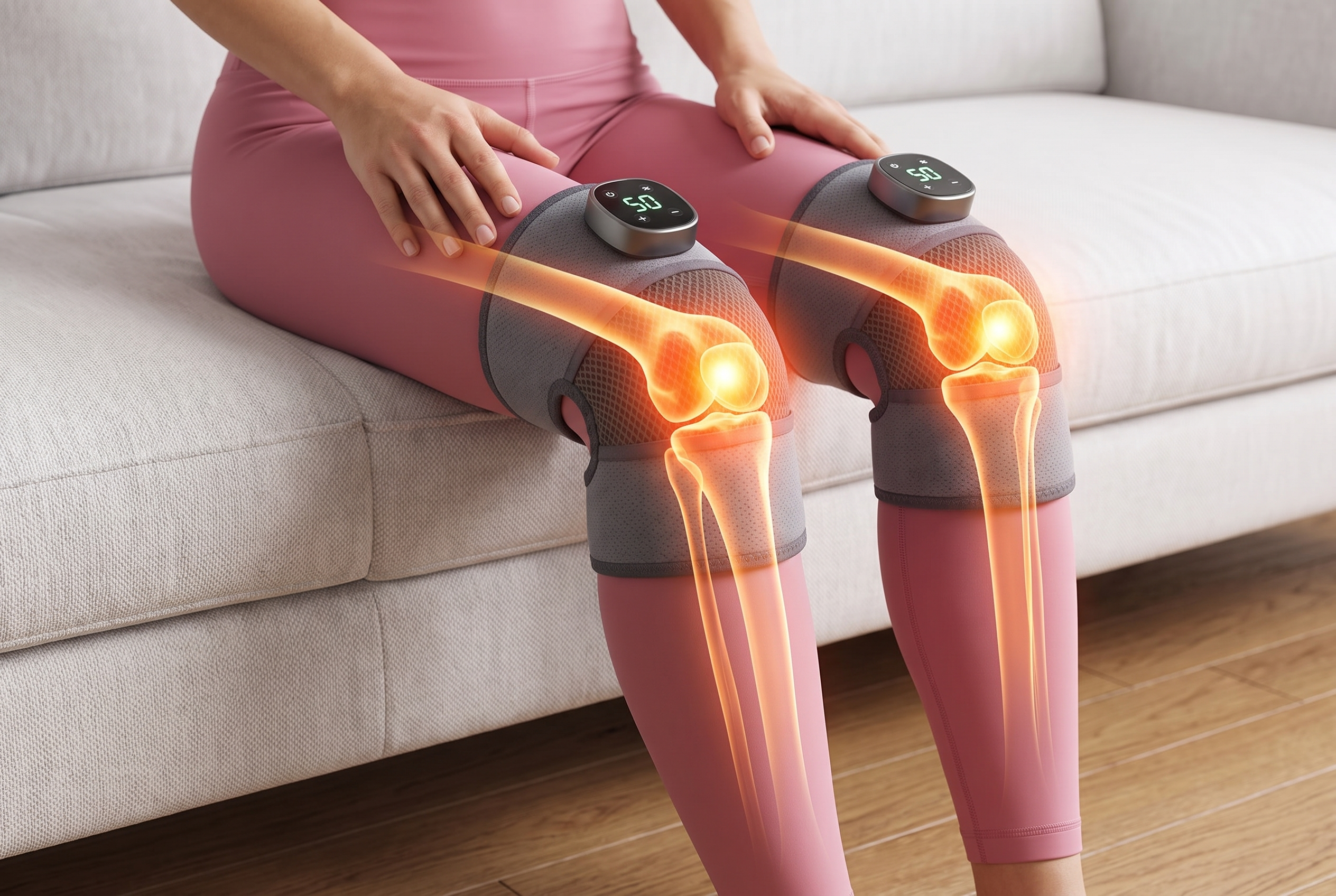
- Deep heat that reaches into the joint, not just the skin surface.
- Kneading massage that loosens the tight muscles holding the knee still.
- Compression that helps the joint fluid move through the cartilage.
One button. Cordless. Fits either knee. You put it on, sit on the sofa, and let it work. It switches off after fifteen minutes.
#1 Stairs Down Hurt More Than Stairs Up
Going up is effort, but going down is pain. A sharper, more specific pain, right behind or around the kneecap.
That is because going down stairs presses your kneecap harder into the joint surface beneath it. When the tissue there is dry and tight, it has nowhere to give. Every step down is a small collision.
Most women start going down one step at a time, leading with the good leg. It works for a while. Then the good leg starts to feel it too, because it has been carrying the load of both.
This is the starvation cycle at the kneecap. The tissue is not getting the fluid it needs, so it tightens, so it hurts under pressure, so you move less, so it gets even less fluid.
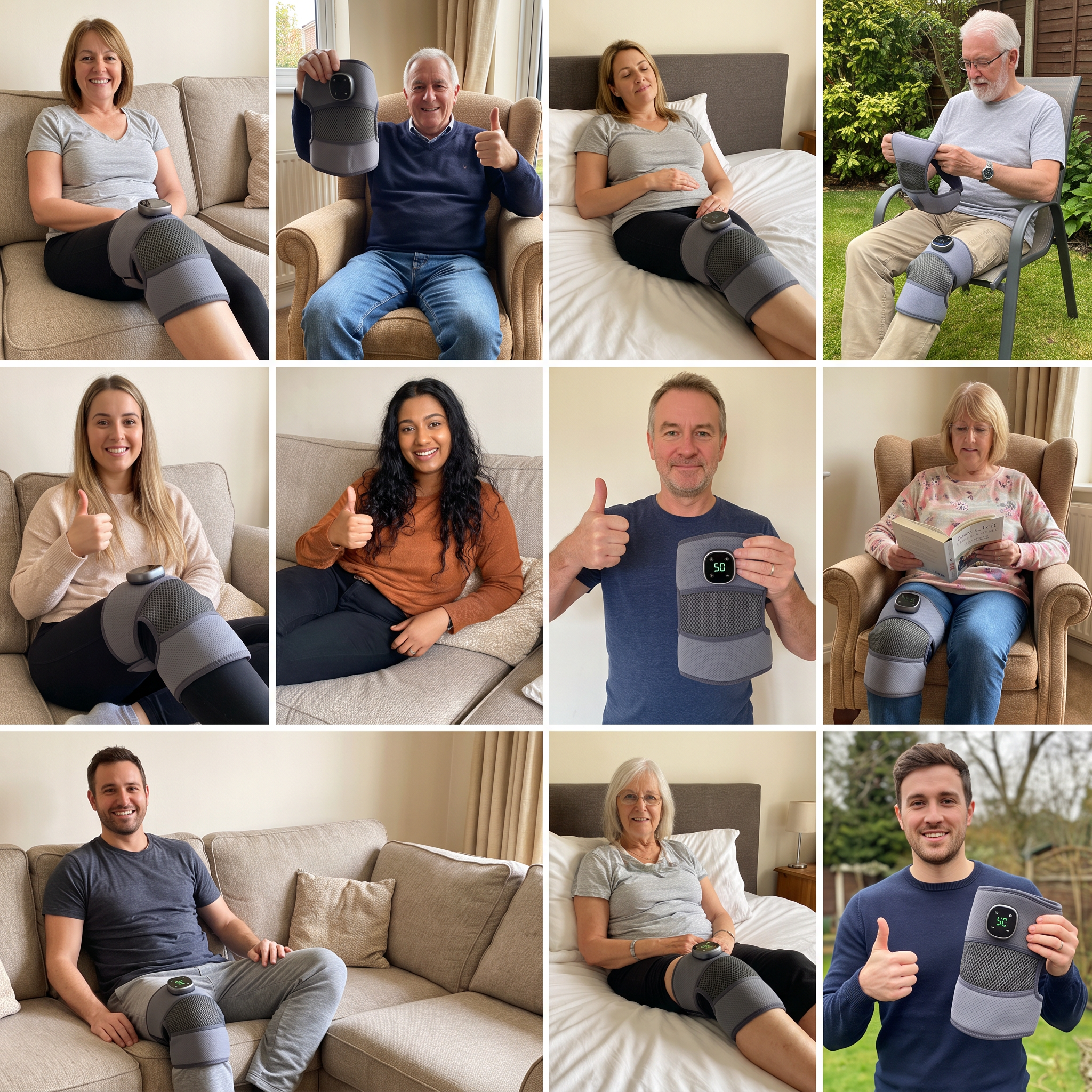
Users report that after two to three weeks of daily sessions, going down stairs felt smoother and they stopped gripping the railing.
#2 The First Steps After Sitting Are the Worst
You stand up from the sofa or the car. The knee feels like concrete. Three, four, five steps, and then slowly it loosens. After a minute of walking it almost feels normal.
This is the clearest proof of the starvation cycle. While you sat still, the fluid in your knee stood still too. Cartilage has no blood supply of its own. It is fed entirely by the joint fluid, and that fluid only circulates when the knee moves under changing pressure.
The moment you start walking, the fluid moves again. The knee softens. The stiffness lifts.
But every time you sit back down, the cycle restarts. The fluid stops. The tissue dries out a little more. And every morning, those first steps take a little longer to loosen.
Users report that the start-up stiffness in the morning became noticeably shorter within the first ten days.
#3 It Hurts More at Night, Doing Nothing
You are in bed. Not walking, not standing, not using the knee at all. And yet it throbs. A deep, dull ache that no position fixes. You try a pillow between the knees, then under them. Neither lasts.
During the day, even limited movement keeps a trickle of fluid circulating. At night, everything stops. The muscles around your knee, which have been tightening for months to protect it, hold it still. The joint sits in its own stagnation for hours.
Pillows change the angle. They do not change the fact that nothing is moving through the joint. The knee needs circulation, not position.
Users report that the deep nighttime ache began to ease after about two weeks of using the device before bed.
#4 You Have Been Told to Wait
"Too young for a new knee. Not bad enough for surgery. Come back when it's worse."
That sentence is not a diagnosis. It is a waiting room. And inside that waiting room, your knee is not standing still. It is sliding.
Here is what waiting looks like: months on a list for a specialist. A cortisone injection that helps for six weeks, then four, then barely two. Physiotherapy twice a week for six sessions, then back on your own. And in between, months where nothing is being done for the knee at all.
Those in-between months are where the starvation cycle does its work. The knee stiffens, the muscles tighten, the fluid slows, the cartilage dries. By the next appointment, the starting point is worse than before.
Whether you end up in surgery or not, how you arrive matters. A knee kept mobile and circulating arrives in a very different condition than one that spent a year sitting still.
Users report feeling more in control of their knee during the waiting period, instead of watching it get worse month by month.
#5 You Rest It, and It Gets Stiffer
This is the one that makes everything click.
You were told to take it easy. So you did. You stopped the long walks. You gave up the garden. You sit more. And the knee got worse, not better.
That is because rest is the starvation cycle. A still knee is a starving knee. The muscles lock around it, the fluid stops, the cartilage gets less of what it needs every day. Rest feels like the kind thing to do. For this knee, it is the opposite.
The way out is not to load the knee harder. It is to give it three things that move fluid and blood through it without any weight on it: warmth that reaches deep into the joint, kneading pressure that works the muscles, and compression that helps the fluid circulate.
Those three things need to happen every day. Not twice a week at a clinic. Every day. That is what breaks the cycle.
Appointments cannot deliver that. Twelve weeks of physiotherapy, two sessions a week, still leaves five days empty. The months between referrals leave the knee entirely on its own.
The RelieveMotion Knee Massager Pro was built for this: deep heat, kneading massage and compression in one cordless wrap you put on at home, press one button, and use for fifteen minutes on the sofa.
Users report that within three to four weeks the knee felt less stuck in the mornings, and they started walking more without planning to.
Why it stands out:
Twelve private physiotherapy sessions cost more than ten times what the RelieveMotion Knee Massager Pro costs, and cover six weeks at best. This is a single purchase at €79,98 (60% off €197,99) that you use every day, as long as you need it.
The 2-pack at €140,80 (€70,40 each) gives you one for each knee, or one to share with your partner.
€79,98 (60% off €197,99) 2-pack: €140,76 (€70,38 each)
30-day money-back guarantee. Free shipping. If your knee does not feel better, send it back.
Click below to get the Knee Massager Pro at 60% off while stock lasts.
Check availability > Save up to 60%Sell-out risk: HIGH


